Then came [Paul] to Derbe and Lystra: and, behold, a certain disciple was there, named Timotheus, the son of a certain woman, which was a Jewess, and believed; but his father was a Greek: Which was well reported of by the brethren that were at Lystra and Iconium. Him would Paul have to go forth with him...
And as they went through the cities, they delivered them the decrees for to keep, that were ordained of the apostles and elders which were at Jerusalem.
And so were the churches established in the faith, and increased in number daily.
When I call to remembrance the unfeigned faith that is in thee, which dwelt first in thy grandmother Lois, and thy mother Eunice; and I am persuaded that in thee also.
The story behind Established In The Faith
Eunice is an example of the Lord's Latter-day instruction that parents in Zion must teach their children to, "understand the doctrine of repentance, faith in Christ the Son of the living God...baptism and the gift of the Holy Ghost by the laying on of hands...to pray, and to walk uprightly before the Lord" (D&C 68:25, 28). Such mothers and fathers establish the foundations of faith in their children, allowing faithful leaders, like the Apostle Paul, to build on the testimonies they planted in the home. Such foundations also enable their posterity to "be not...ashamed of the testimony of our Lord" (2 Timothy 1:8), and to "Hold fast...in faith and love which is in Christ Jesus" (2 Timothy 1:13).
Eunice was able to engender this reliance on and trust in Christ "in" her son (see 2 Timothy 1:5), despite the "wholly Gentile and pagan culture" in which her homeland was steeped (Zondervan 332), and a husband who, presumably, did not share her faith (see Acts 16:1). This remarkable mother's "unfeigned faith" nurtured her child to become what one Bible Dictionary describes as "Paul's most trusted and capable assistant" (Dictionary 785).
The fact that Eunice's faith enabled her to raise her son in such protective righteousness gives hope to each of us that, amidst the backdrop of secularism and atheism in which we find ourselves, we too can raise a posterity who is true to the faith.
Symbolism in Established In The Faith
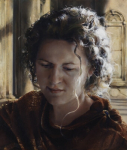
Symbolically, the only pure light visible in the image is found touching her person. It does not extend to the elements representing the culture of the world. The brilliant highlights bathing her hair in beauty represents the light with which faith in Christ bathes the possessor of it. It is this light which enlivens her being, just as the light of Christ enlivens all who have their eye "single to [God's] glory" (see D&C 88:67).
The color of the Roman-style "palla" draped about her shoulders was produced anciently by using a dye extracted from the madder root (see Yadin, 173). Here, this reddish color is intended to remind the viewer of the atoning blood of Christ, which enables those obedient to His commandments to be "clothed with purity, yea, even with the robe of righteousness" (2 Nephi 9:14), even when he or she may be surrounded by the threatening influences of the world. The gold embroidery visible on her palla was fashionable in Rome prior to Eunice's day (see Sebesta 68).
Copyright and terms of use
© By Elspeth Young, All Rights Reserved. You may not print, copy, or reproduce this artwork or make derivative works from it without the prior written consent of the copyright holder. For permissions, please review our FAQ page.From the Newsroom
By Al R. Young
only high-end custom frames
We have framed our own artworks for more than 30 years, and during that time we have provided a variety of framing services to patrons upon request. For many reasons—including constant changes in the availability of moulding styles—we cannot offer off-the-shelf framing options or response times typically associated with such a service. Of necessity, all of our framing projects are aproached, priced, and billed as constuling projects... Read more »
Tags: Into The West, Spring Rain, North Country, The Grey Havens, Journey's End, Looking Back, Enchanted Stillness, Bedtime Story, In The High Valley, The Daydream, Before The Ball, Old Shannon, Pavane, Sweet Brier, Legend, Mountain Home, And I...
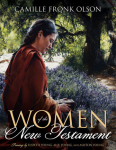
By Al R. Young Women of the New Testament by Camille Fronk Olson is the companion volume to Women of the Old Testament, published by Deseret Book in 2009.
The New Testament volume features fifty six illustrations from the Artists of Al Young Studios, listed here under the Studios' fine art collections and portfolios to which they belong.
From the Women of the Bible Fine Art CollectionFull-color details (cropped images) from the following 29 paintings appeared in the book (in the order in which they appear here)... Read more »
Tags: I Shall Be Whole, I Say Unto Thee, Arise, The Windows Of Heaven, The Miracle Of Forgiveness, What Is Truth, Under Whose Wings Thou Art Come To Trust, Unto The City Of David, A Damsel Came To Hearken, By The Wayside, Living Water, Waiting...
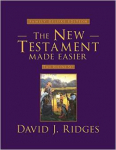
By Al R. Young
The New Testament Made Easier, published by Cedar Fort, featured five original oil paintings by Elspeth Young and one of Ashton Young's original oil paintings, all from Al Young Studios' Women of the Bible Fine Art Collection.Go Forth To Meet The BridegroomAnd Martha ServedAnd He Shall Direct Thy PathsShe Worketh Willingly With Her HandsEstablished In The FaithA Damsel Came To Hearken... Read more »
Tags: A Damsel Came To Hearken, And He Shall Direct Thy Paths, She Worketh Willingly With Her Hands, Established In The Faith, And Martha Served, Go Forth To Meet The Bridegroom, 3rd-party Publications, 2014, News
By Al R. Young
High-resolution digital copies are available from the Studios for use as illustrations. Use the serial number—appearing below the thumbnail—in requesting permission from the Studios (see links at the bottom of this page for detail).
The correct form of attribution when publishing an image is specified in the license agreement issued to the publisher by Al Young Studios.Guidelines for requests to copy or publish artworks created by the Artists of Al Young Studios
Guidelines for commissioning Al Young Studios to create illustrations
Return to this portfolio
Browse all portfolios
Browse Newsroom articles about Illustration
The original image is available for sale, please contact us for details... Read more »
Tags: Established In The Faith, 2009, People and Stories of the Bible
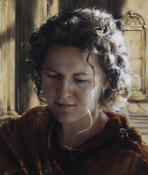
By Al R. Young Established In The Faith is the newest oil painting to be added to the line of original artworks from Al Young Studios.
Click here to see a larger image of the new painting, read the artist's commentary, and look at the selection of prints--if any are available.... Read more »
Tags: Established In The Faith, 2009, Elspeth C. Young, Legacy, News, Oil paintings and prints, Women of the Bible Art Collection